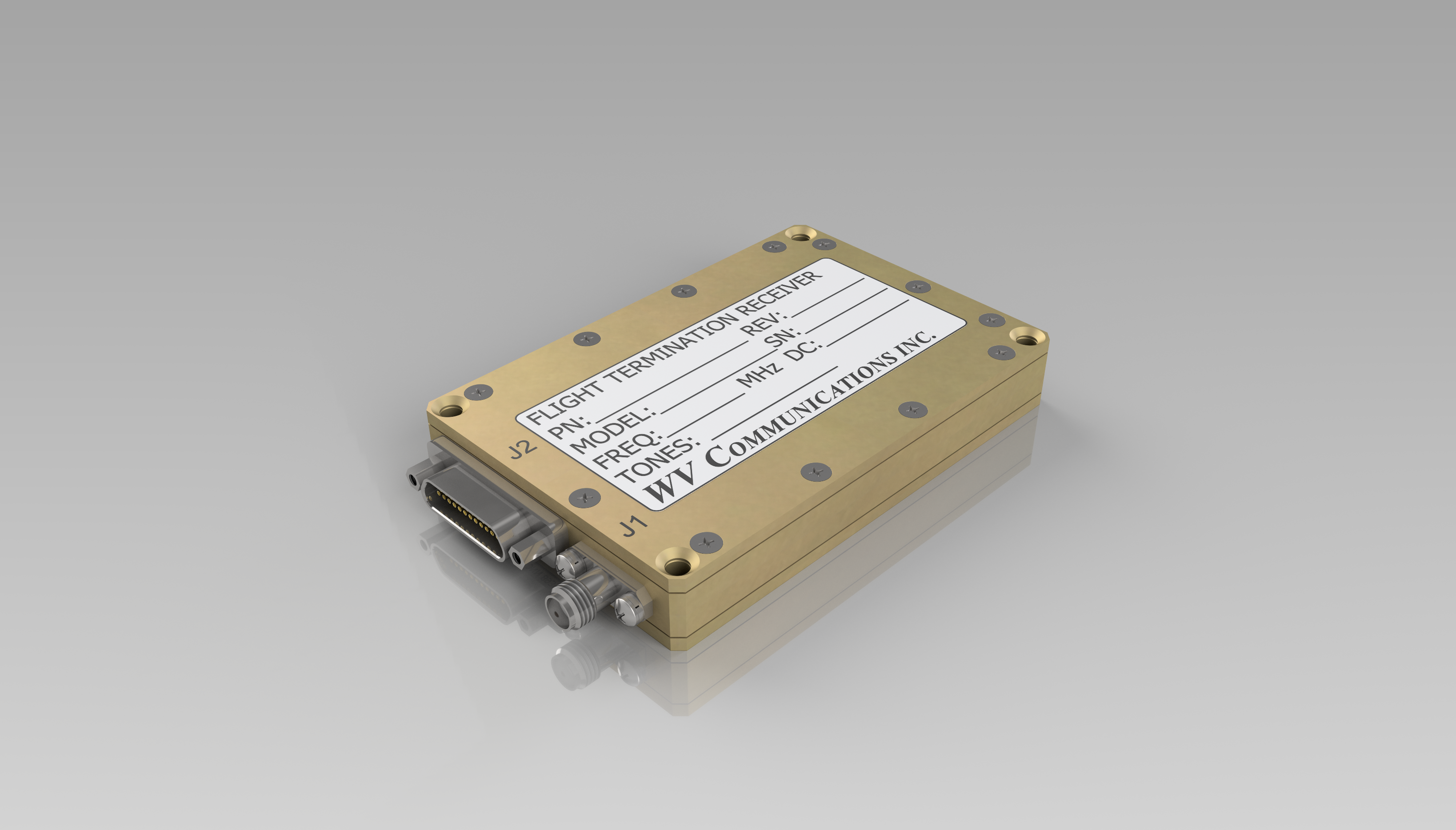
Flight Termination Receiver
Model: IFTR1001 / EFTR1001
IRIG and EFTS versions · 420–450 MHz
Or call (805) 376-1820
- ISO 9001:2015
- IPC-A-610 Class 3
- ITAR Registered
WV’s flight termination receiver comes in two versions: the IFTR1001 for IRIG commands using three or four tones and the EFTR1001 for EFTS commands. Built on a software-defined radio (SDR), it operates anywhere from 420 to 450 MHz. The IFTR1001’s frequency and tone set are programmed at the factory, and the EFTR1001’s frequency is user selectable in 100 kHz steps. It is compliant with RCC 319-25 and RCC 313-01 and builds on WV’s 24 years of flight termination system experience.
The FTR is the airborne endpoint of WV’s flight termination systems, so your complete system, ground and airborne, can come from one supplier.
Features
- Software-defined radio (SDR)
- 420–450 MHz, factory programmed (IFTR1001) or user selectable in 100 kHz steps (EFTR1001)
- IRIG commands using three or four tones, factory set (IFTR1001)
- EFTS commands (EFTR1001)
- RCC 319-25 and RCC 313-01 compliant
- Failsafe operation, with optional redundant cross-strapping
- Compatible with WV ground FTS equipment
Specifications
- Frequency Range
- 420–450 MHz
- Frequency Selection
- Factory programmed (IFTR1001); user selectable in 100 kHz steps (EFTR1001)
- Tuning Accuracy
- 5 ppm
- Sensitivity
- -116 to -107 dBm
- RF Input Dynamic Range
- -107 to +13 dBm
- Rejection
- > 60 dB
- RF Input Impedance
- 50 Ω nominal
- RF Input VSWR
- < 2:1
- Command Format
- IRIG, three or four of the 20 IRIG tones, factory set (IFTR1001); EFTS (EFTR1001)
- Failsafe
- Configurable: none, standard or commanded (IFTR1001)
- Input Voltage
- +22 to +36 VDC nominal
- Reverse Voltage Protection
- +45 VDC
- Input Power
- 3 W typical
- Operating Temperature Range
- -40 to +85 °C
- Dimensions
- 3.30 × 2.20 × 0.50 in (L × W × H)
- Weight
- 5 oz maximum
- Architecture
- Software-defined radio (SDR)
- Compliance
- RCC 319-25 and RCC 313-01
Resources
Custom Configurations
The Flight Termination Receiver can be configured to your program’s requirements. Tell us the application’s needs and an engineer will follow up directly.
Discuss Your Requirements →Include your application, frequency band, power level, form factor and timeline.
Open in email appOr call (805) 376-1820